


Small Companies Take the Lead
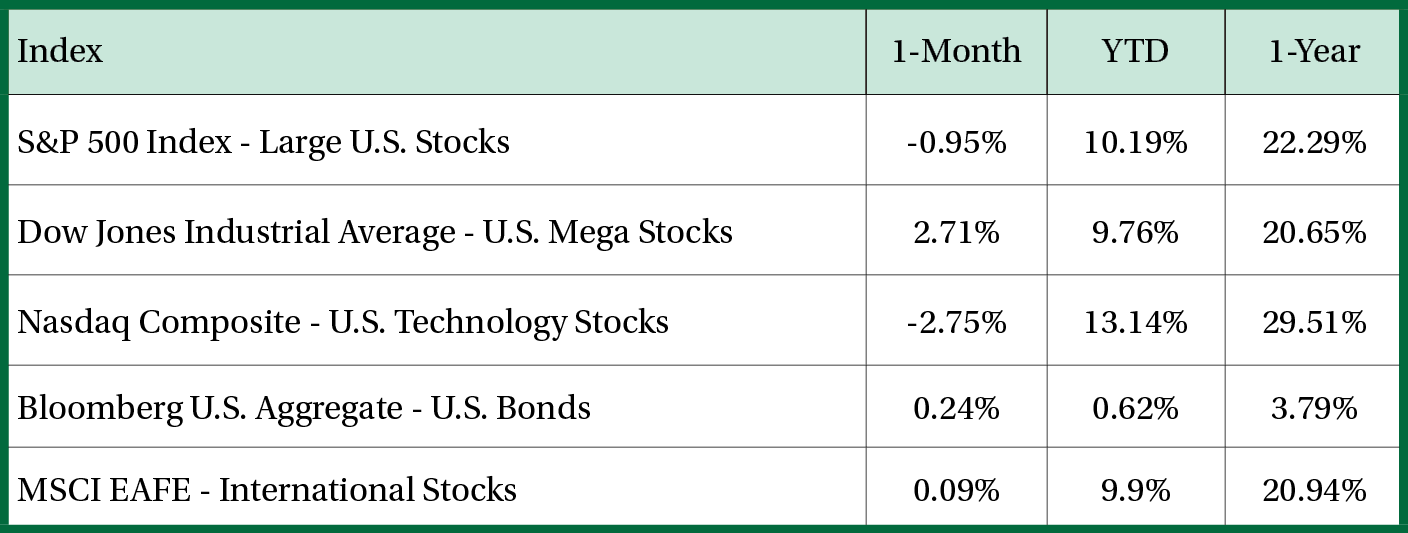
The Russell 2000 index, a representation of small-cap stocks, returned 3.7%, while the large-cap equity S&P 500 index returned -1%. The performance dispersion was a result of each market’s composition. The S&P 500 index consists of more technology, while the Russell 2000 index has a composition more focused on Financials, Industrials, and Healthcare. Financials benefited from their loans repricing on higher short-term interest rates, while industrials continue to be supported by better-than-expected economic activity. As for healthcare, the Russell 2000 index has a higher allocation to pharmaceuticals and biotechnology, which continues to exhibit outsized gains this year.
Oil Retreat Continues
The price of West Texas Intermediate crude oil declined -$17.9 per barrel in June after dropping -$17.7 per barrel in May to close the 2nd quarter at a level below $70 per barrel. This would be the largest quarterly drop in six years after a ceasefire announcement in June meant for more ships passing through the Strait of Hormuz to fulfill demand. As a result, large-cap equity energy stocks tracked the decline in oil prices, falling -13.5% in the second quarter. Although, the more stable energy infrastructure segment ended the quarter in positive territory, which underscores its consistent earnings amidst oil volatility. Energy infrastructure companies, in some cases, transport the raw material to be processed for the consumer, which is not usually affected by the price of oil. This makes energy infrastructure companies a desirable component of a portfolio given their yield and business stability.
Bonds Deliver Gains in June
A decline in inflation expectations and the Federal Reserve (Fed) insistence of bringing down inflation was the reason behind a flattening of the Treasury rate curve. Long-term interest rates remained stable during the month, as the 10-year Treasury yield ended June flat at a level of 4.46%, while the 2-year Treasury yield advanced 0.17% to a level of 4.17%. Investors see an increased likelihood of the Fed hiking interest rates to stave off inflationary pressures built on supply side shocks and better-than-expected demand. Riskier bonds were affected by shaky equity markets, supporting the Treasury bond market to outperform bonds with the riskiest credit ratings.
New Era at the Federal Reserve
Federal Reserve (Fed) Chairman Kevin Warsh’s first two-day Federal Open Market Committee (FOMC) meeting gave insight into plans going forward. Some market participants were skeptical of the direction Fed Chairman Kevin Warsh would take, given his history of preferring lower interest rates. However, it was clear based on the post-meeting press conference that inflation’s persistence will be the Federal Reserve’s primary focus - “we’ve missed for five years, and we’re going to fix that.” As a result, the market is now pricing a 0.25% rate hike by the end of the year to an upper-bound target rate of 4%.
Consumption Accelerates
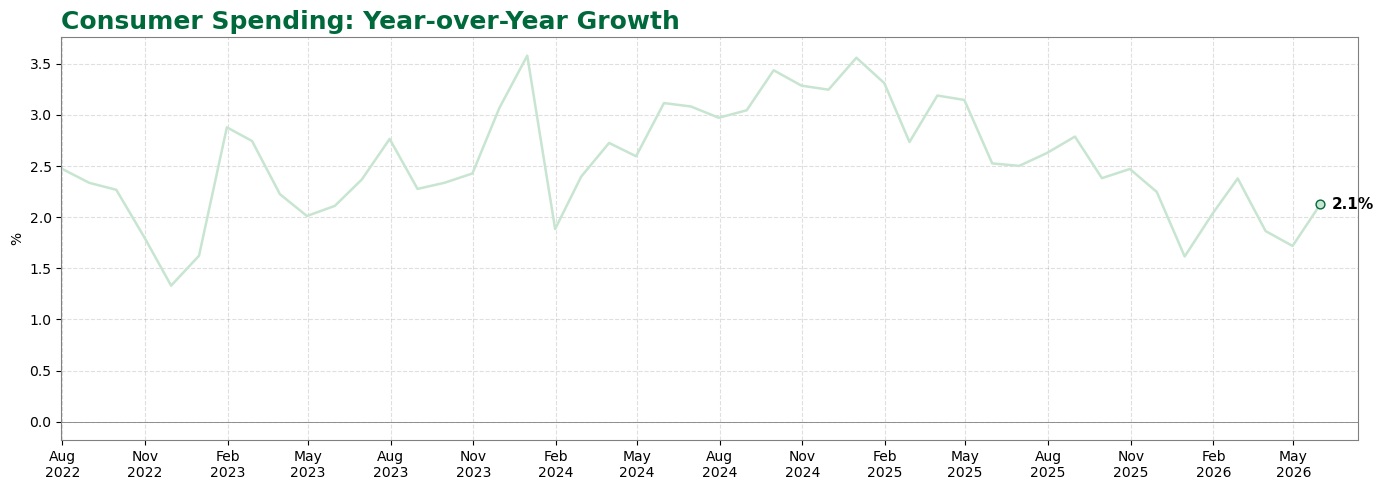
U.S. consumer spending, adjusted for inflation, rose 2.1% from a year earlier in May, as spending advanced 0.3% from a month earlier. There are three reasons for better consumption: higher-than-usual tax refunds, improving labor market and rising stock prices. However, overall pay gains have not kept up with inflation, with declining savings and credit card usage being the options to cover the gap. Considering all factors contributing to consumption, the economy remains supportive of consumption trends.
Although we believe it to be reliable as of the publication date and have sought to take reasonable care in its preparation, all information provided is FOR INFORMATIONAL PURPOSES ONLY and we make no representations or warranties regarding its accuracy, reliability, or completeness and assume no duty to make any updates in the event of future changes. Past performance may not be indicative of future market results. Any examples used (including specific securities) are generic and meant for illustration purposes only and are not, and should not be interpreted as, offers to buy or sell such securities. To the extent indices are referenced, please note that you are not able to invest directly in an index.
Nicolet Wealth Management is a brand name that refers to Nicolet National Bank and certain of its departments and affiliates that provide investment advisory, trust, retirement plan level services, and insurance services. Investment advisory services offered through Nicolet Advisory Services, LLC (dba Nicolet Wealth Management), a registered investment advisor.
All investments are subject to risks, including possible loss of principal, and are: NOT FDIC INSURED; NOT INSURED BY ANY FEDERAL GOVERNMENT AGENCY; AND NEITHER DEPOSITS OR OTHER OBLIGATIONS OF, NOR GUARANTEED BY, Nicolet National Bank or any of its affiliates. Neither Nicolet Advisory Services nor its affiliates offer tax or legal advice. You should consult with your legal and tax professionals before making investment decisions.
Listen & Subscribe to our Podcast
Tune in for the next episode, subscribe or follow us wherever you listen to podcasts.