


Earnings Fuel August Rally
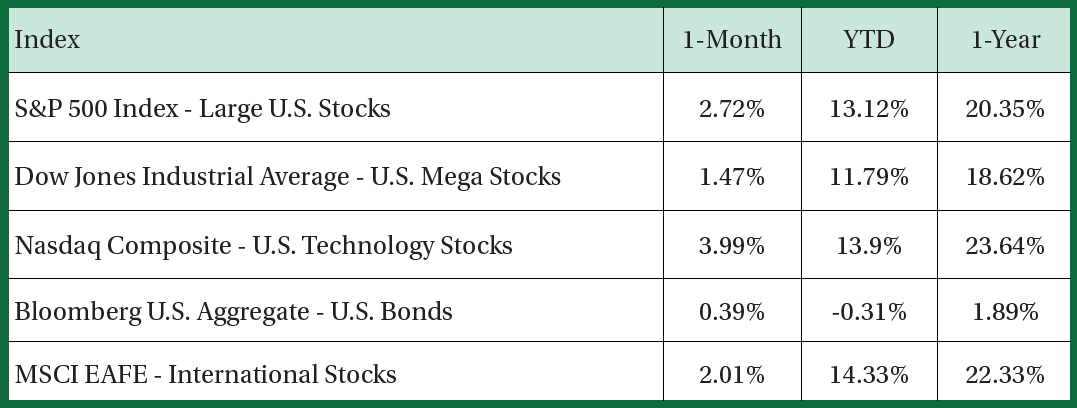
On the back of another robust earnings season (the second quarter of 2026 delivered earnings growth of 52% on revenue growth of 15.5%), global stocks returned just under 3% in August. The S&P 500 index (U.S. large-cap stocks) advanced 2.7%, while the MSCI ACWI ex USA (international stocks) returned 2.6%, with Emerging Markets fueling much of the gains. This is a positive development as stocks in September usually hit a period of contraction. On average, the S&P 500 index has lost 0.8% on average in September over the last three decades, compared to an average 0.9% gain over the other 11 months.
Artificial Intelligence Buildout Fuels Demand for Chips
Nvidia’s second quarter earnings report provided positive insight into the economically important Artificial Intelligence (AI) buildout. Nvidia is forecasting 70% revenue growth for the next fiscal year, which is above expectation. Most importantly, Nvidia said growth expectations would be higher if supply constraints weren’t so significant. It isn’t just Nvidia reaping the benefit of this buildout, the entire Information Technology sector is expected to grow 82% over the next year, surpassing S&P 500 index growth of 36%. As a result of this earnings momentum, Nasdaq Composite returned nearly 4% in August, compared to the broad market of 3%. Despite strong earnings arising from Information Technology, earnings growth benefactors should evolve to other segments of the stock market.
Federal Reserve Rate Hike in September?
At the annual Federal Reserve (Fed) Jackson Hole Economic Policy Symposium, Fed Chair Kevin Warsh noted that inflation isn’t meaningfully slowing, which led to a big turn in rate hike expectations for September. The probability of a 0.25% rate hike in September increased from 36% on August 27 to 58% on August 28, the day of the Jackson Hole Economic Symposium. Specifically, Warsh noted that inflation will return to its 2% goal, which he said is a firm and fixed target. Currently, the Consumer Price Index (CPI) is running at a 3.4% year-over-year level. However, inflationary pressures are a result of supply-side factors, such as energy costs, which should react very little to higher interest rates.
Manufacturing Activity Accelerates
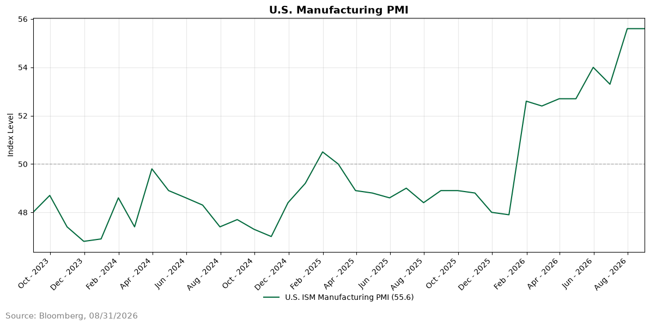
The Institute for Supply Management’s July manufacturing gauge rose to 55.6, the highest level since May 2022 – any readings above 50 indicate growth, with manufacturing being in expansion for seven consecutive months. The main reasons for this expansion were manufacturing production rising to the highest level since late 2021 and employment increasing for the first time since September 2023. Factories are benefiting from resilient consumer demand, solid business investment and government outlays on defense. In addition to production and employment, exports rose to the highest level since March 2022.
Interest Rates Swing
While the 10-year Treasury yield remained within a range of 4.6%-4.74% for August, the interest rate level tested the maximum and minimum level multiple times. Treasury Secretary Scott Bessent announced a “treasury twist” to sell shorter maturity treasuries in order to fund the purchases of long maturity treasuries. In addition to the Secretary Bessent’s plan, Federal Reserve Chair Kevin Warsh’s insistence of fighting inflation increased interest rate uncertainty as the summer concludes. The U.S. isn’t the only country dealing with higher interest rates, as inflation and the compensation investors require to purchase longer maturity bonds continues to rise.
Although we believe it to be reliable as of the publication date and have sought to take reasonable care in its preparation, all information provided is FOR INFORMATIONAL PURPOSES ONLY and we make no representations or warranties regarding its accuracy, reliability, or completeness and assume no duty to make any updates in the event of future changes. Past performance may not be indicative of future market results. Any examples used (including specific securities) are generic and meant for illustration purposes only and are not, and should not be interpreted as, offers to buy or sell such securities. To the extent indices are referenced, please note that you are not able to invest directly in an index.
Nicolet Wealth Management is a brand name that refers to Nicolet National Bank and certain of its departments and affiliates that provide investment advisory, trust, retirement plan level services, and insurance services. Investment advisory services offered through Nicolet Advisory Services, LLC (dba Nicolet Wealth Management), a registered investment advisor.
All investments are subject to risks, including possible loss of principal, and are: NOT FDIC INSURED; NOT INSURED BY ANY FEDERAL GOVERNMENT AGENCY; AND NEITHER DEPOSITS OR OTHER OBLIGATIONS OF, NOR GUARANTEED BY, Nicolet National Bank or any of its affiliates. Neither Nicolet Advisory Services nor its affiliates offer tax or legal advice. You should consult with your legal and tax professionals before making investment decisions.

Listen & Subscribe to our Podcast
Tune in for the next episode, subscribe or follow us wherever you listen to podcasts.