


U.S. Companies Grow at Rapid Pace
With 61% of the S&P 500 (largest U.S. companies) reporting earnings, this is expected to be the highest earnings growth rate since the 2nd quarter of 2021 with a growth rate of 47.4%. The earnings growth rate has advanced from 23.2% on June 30 on strong results from Amazon, Alphabet, and Micron Technology, in particular, for the highest surprise since 2008. This is a result of strong earnings breadth, as 86% of the S&P 500 reporting a positive earnings surprise and 77% reporting a positive revenue surprise, marking the highest percentage of companies reporting a surprise. There are eight sectors expected to report double-digit earnings growth rates for the quarter, led by Energy, Communication Services, Consumer Discretionary, and Information Technology.
Better than the Headline Suggests
The U.S. economy grew 1.5% annualized in the second quarter of 2026 after adjusting for inflation, less than the growth rate of 2.1% in the first quarter. However, the composition of growth was strong, including consumer spending and nonresidential fixed investment. Consumer spending rose 3.2% on supportive fiscal policy (tax-returns) and World Cup related spending. Nonresidential fixed investment advanced 8.4% on better industrial and transportational equipment spending, likely because of growing capacity for artificial intelligence. Also adding to the growth was investment in housing, which increased 1.5% for the first time since the end of 2024. As expected, net trade weighed significantly on total growth due to sharp price increases in oil imports.
Fed Remains on Hold
Despite a hawkish tune after the Federal Open Market Committee (FOMC) decision, members of the FOMC decided to keep interest rates unchanged at a range of 3.5-3.75% for the fifth consecutive meeting. However, there were 3 members who dissented in favor of raising rates by 0.25% to curb rising prices. The Federal Reserve is debating whether increasing rates is the true solution for inflation that was drifting lower prior to the Iranian conflict that sent energy prices higher. One positive note from the Federal Reserve was its assessment of the U.S. economy growing a “solid pace,” supported by capital investment and productivity growth.
Change in Market Leadership
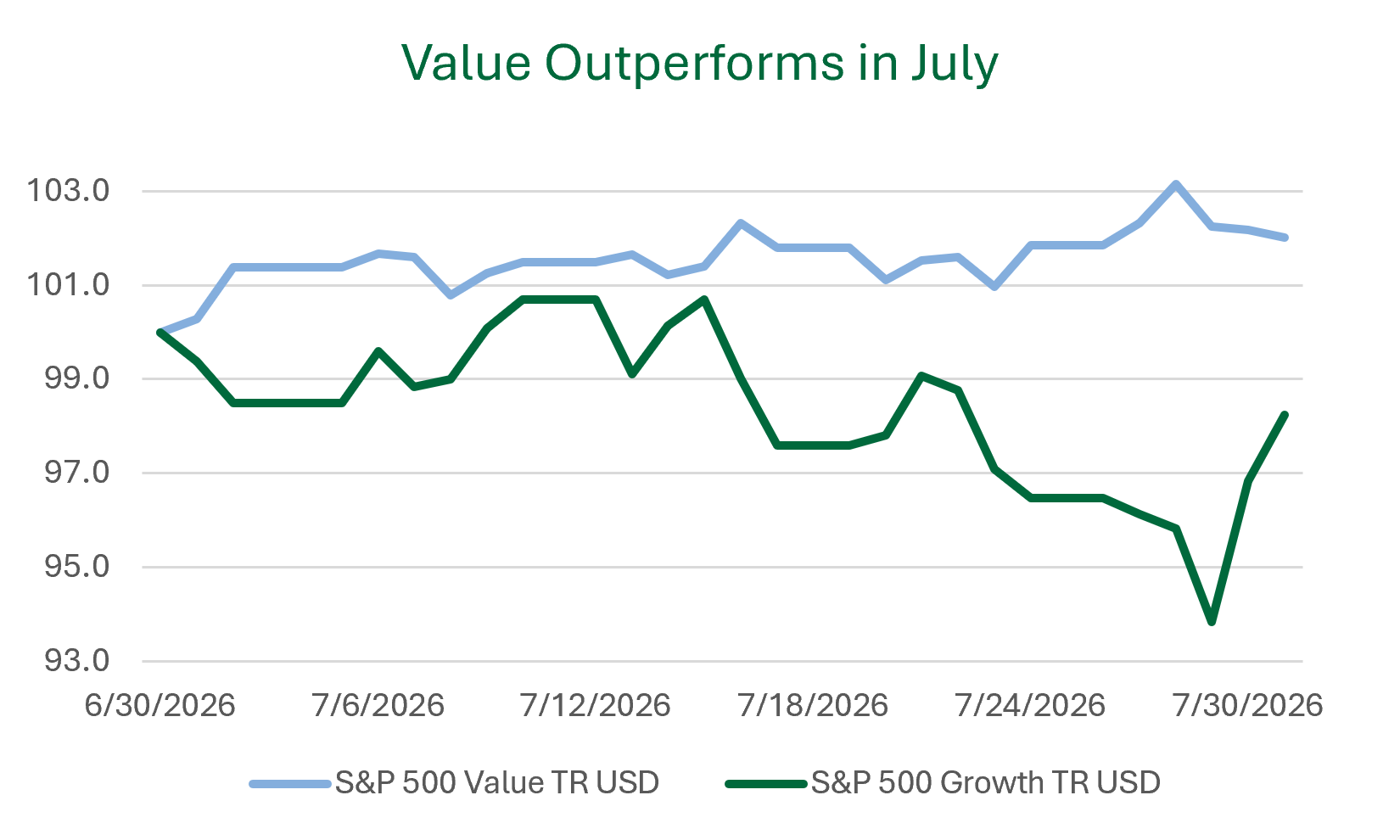
While the S&P 500 index gave up gains in July after strong returns in the second quarter, there was a noticeable shift in leadership. The S&P 500 Value index (Financials, Industrials, Energy, etc.) advanced 2% and the S&P 500 Growth index (Technology, Communication Services, etc.) decreased -1.8 % in July, which tilted the year-to-date performance in favor of value stocks. A few reasons can explain this shift. Investors are becoming increasingly critical of technology stock’s massive spending plans, preferring the income value stocks produced amidst rising interest rates and the value segment’s position with building out infrastructure. Through the duration of 2026 and
into 2027, value stocks are expected to see their earnings growth match the growth segment.
Historical market performance is not a guarantee of future results.
Investors cannot directly invest in an index
Rates Drift Higher
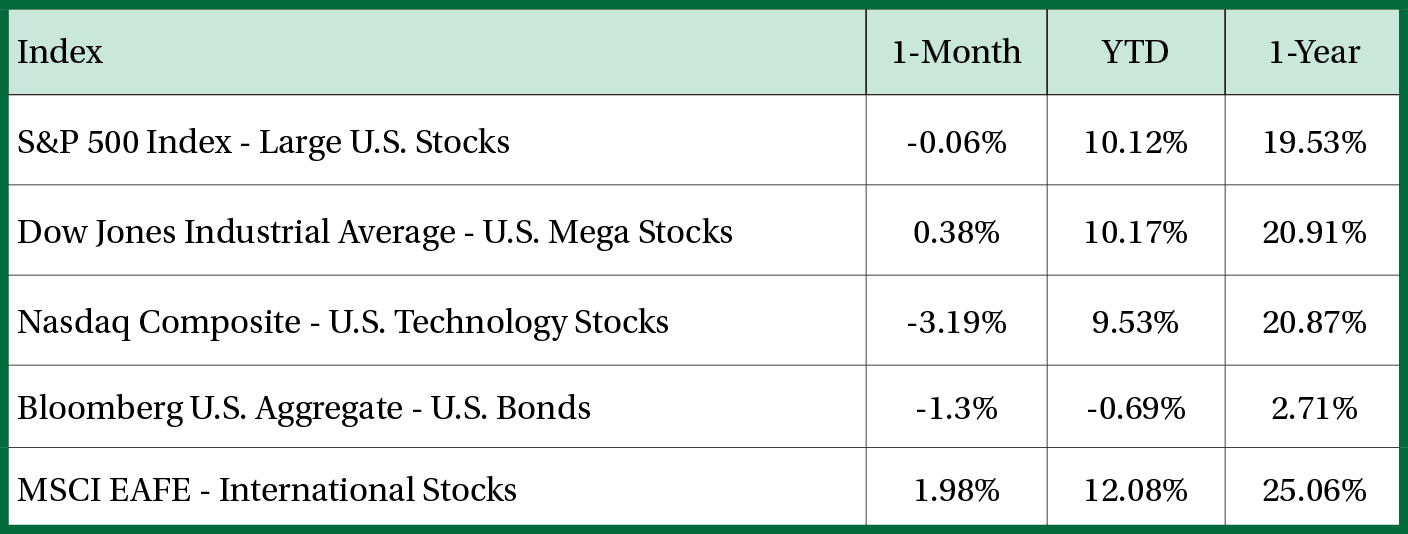
A reacceleration of inflation and better growth prospects have led to higher rates at longer maturities. The 10-year Treasury yield increased nearly 0.3% in July to a level of 4.74%. Market participants see an extended conflict in the Middle East as a reason for higher inflation for longer. As a result, bonds with longer maturities and thus greater interest rate risk saw their prices decline more than bonds with shorter maturities. This was evident in the relative performance of investment grade and high yield bonds. Investment grade bonds dropped -1.7% and high yield bonds declined -0.3% in July. This relative performance occurred despite overall weakness in equity markets that would have an outsized effect on high yield.
Although we believe it to be reliable as of the publication date and have sought to take reasonable care in its preparation, all information provided is FOR INFORMATIONAL PURPOSES ONLY and we make no representations or warranties regarding its accuracy, reliability, or completeness and assume no duty to make any updates in the event of future changes. Past performance may not be indicative of future market results. Any examples used (including specific securities) are generic and meant for illustration purposes only and are not, and should not be interpreted as, offers to buy or sell such securities. To the extent indices are referenced, please note that you are not able to invest directly in an index.
Nicolet Wealth Management is a brand name that refers to Nicolet National Bank and certain of its departments and affiliates that provide investment advisory, trust, retirement plan level services, and insurance services. Investment advisory services offered through Nicolet Advisory Services, LLC (dba Nicolet Wealth Management), a registered investment advisor.
All investments are subject to risks, including possible loss of principal, and are: NOT FDIC INSURED; NOT INSURED BY ANY FEDERAL GOVERNMENT AGENCY; AND NEITHER DEPOSITS OR OTHER OBLIGATIONS OF, NOR GUARANTEED BY, Nicolet National Bank or any of its affiliates. Neither Nicolet Advisory Services nor its affiliates offer tax or legal advice. You should consult with your legal and tax professionals before making investment decisions.

Listen & Subscribe to our Podcast
Tune in for the next episode, subscribe or follow us wherever you listen to podcasts.